
Frequently Asked Questions
Industrial livestock operations, also known as factory farms or concentrated animal feeding operations (CAFOs), hold thousands—sometimes millions—of animals in confined spaces without access to open air or pasture.
Today in the U.S., most meat, dairy, poultry, and eggs are produced in industrial operations controlled by a handful of multinational corporations.
Factory farms generate vast quantities of waste, which pollutes the air and water, threatens public health, and degrades rural communities.
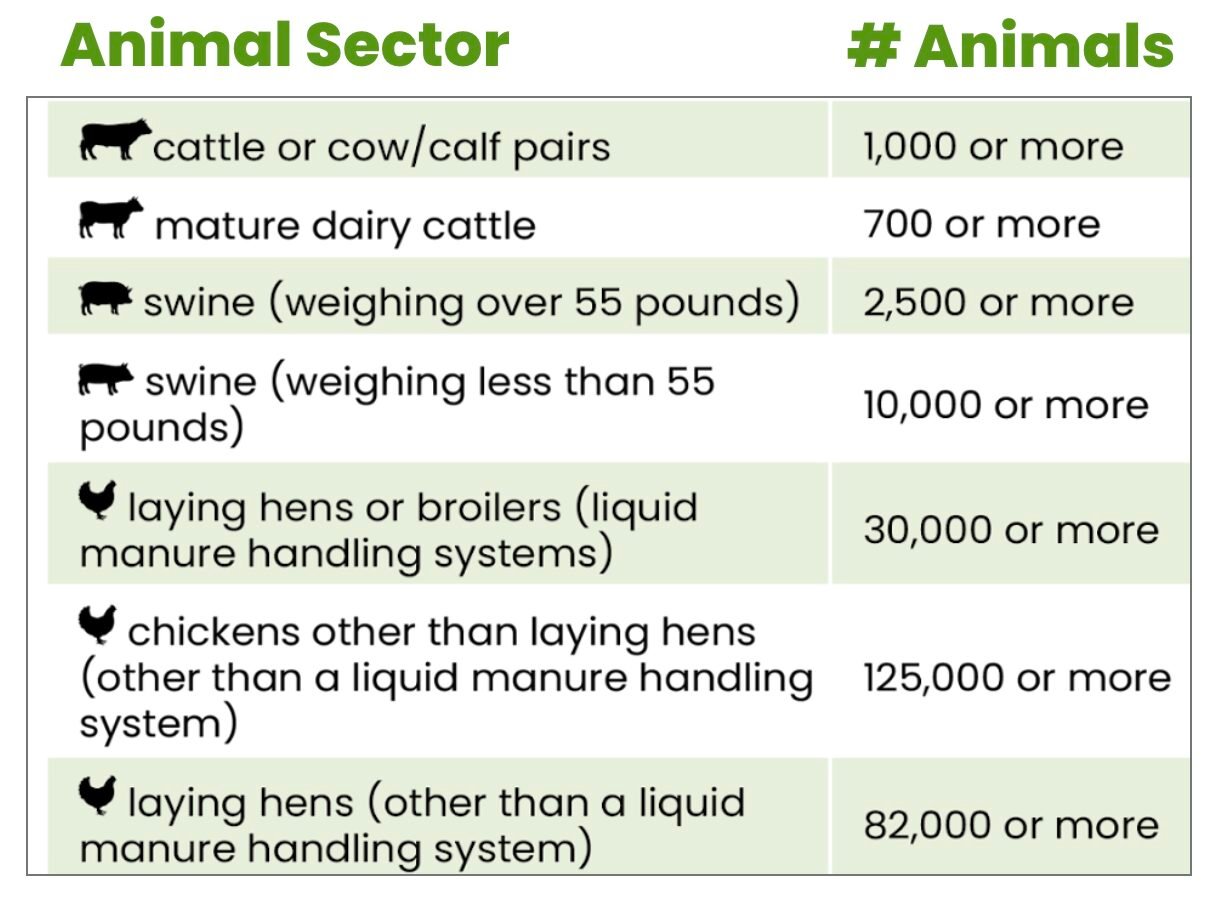
A concentrated animal feeding operation (CAFO) is a livestock operation that meets the following conditions as defined by the U.S. EPA:
- The animals are confined for at least 45 days during any 12-month period.
- Crops, forage growth, and other vegetation are not grown in the area where the animals are confined.
- Large CAFOs have at least 1,000 animal units. One animal unit typically represents 1,000 pounds of live animal weight.
Most meat, dairy, poultry, and eggs are no longer produced on idyllic pasture-based farms. Instead, our food supply chain is dominated by only a handful of meat companies that have industrialized the livestock industry. This has led to an increase in factory farming with thousands—even millions—of animals raised in confined spaces, and a decrease in small-scale, family-run farms.
Factory farming emphasizes business profit and scale over the health and safety of people, animals, and the land.
The extreme concentration of animals into confined spaces pollutes air, soil, and water, threatens public health, compromises animal welfare, damages local economies, and decreases the quality of life in surrounding communities.
Learn more about water pollution and how SRAP works with communities to protect themselves.
Hear directly from community members harmed by factory farms in their communities:
The term factory farming refers specifically to the method of raising very large numbers of chickens, cows, hogs, and eggs in confinement.
Industrial agriculture includes factory farming, but it also includes intensive crop production using pesticides and synthetic fertilizers and other mass agriculture practices.
These are mostly used as marketing terms to help sell meat and animal products; they are not based on set legal standards. However, the most frequently accepted definitions are:
- Pasture-raised: Animals spend a significant amount of time outdoors on pasture, where they can graze and engage in other natural behaviors.
- Free-range: Animals spend some time outdoors, but the amount of time and quality of the space can vary widely. In some cases, the amount of outdoor space can be very small and not used very often.
- Cage-free: This usually refers to hens, and means the birds are not kept in individual cages. They may still be housed in barns with thousands of other birds, though, and cage-free does not mean the animals have outdoor access.
Learn more about welfare labels from A Greener World, which administers “Certified Animal Welfare Approved by AGW,” one of the few meaningful animal welfare certifications.
Factory farms are found throughout the U.S. and have been intentionally sited in rural areas where residents oftentimes lack the political and economic resources to protect themselves. These operations are also disproportionately built near low-income and Black, Indigenous, and Latine communities, a major environmental injustice that has existed for decades.
SRAP has created a mapping tool to help track the geographic patterns, trends, and characteristics of factory farming in the U.S. Our GIS Portal is designed as a resource for advocates and communities facing incoming and existing industrial livestock operations. The tool compiles publicly available data and map layers from government, academic, and other sources.